Showing posts with label civil liberties. Show all posts

19/05/2010

If we allow Manchester terrorists to be tortured, we are barbarians ourselves

Un-named British authorities and the right-wing press woke up and got themselves in a right old tizzy this morning over the news that two terrorism suspects, believed to have links to Al-Qaeda, will be allowed to remain - almost certainly under house arrest and subject to control orders - in the UK as they would face torture if deported to Pakistan.

23-year-olds Abid Naseer and Ahmed Faraz Khan are accused of plotting to cause a "mass casualty 7/7-style bomb attack" to have taken place in Manchester last year, probably at the Arndale Shopping Centre during Easter. Police carried out raids at short notice on the pair after the ironically-named Met Head of Terrorism Bob Quick accidentally blurted details of the operation to photographers for which he later lost his job - the haste with which they were carried out led to police failing to gather sufficient evidence and the men being released without charge two weeks later. To date, they have not been charged with any offence and no bomb-making equipment was discovered, but police obtained copies of e-mails believed to contain coded plans outlining the attack.
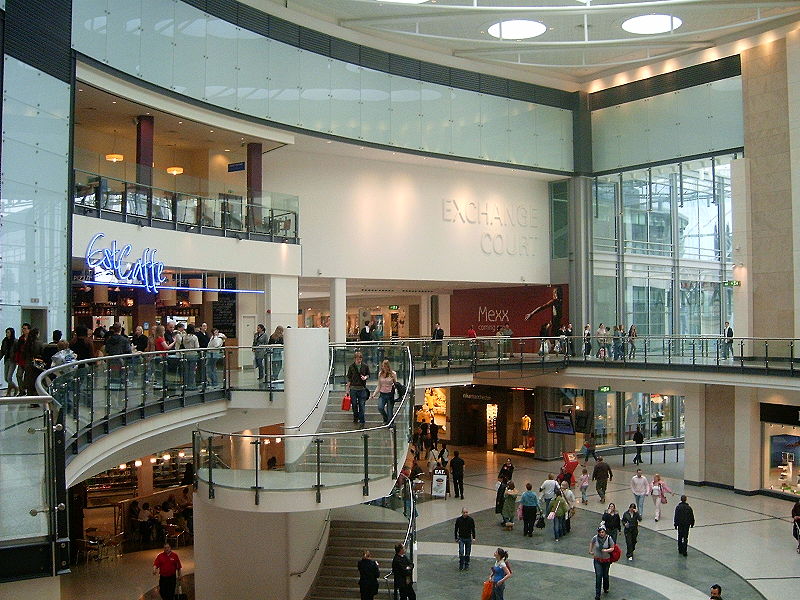
Part of Manchester's enormous Arndale Centre, the largest city centre shopping mall in Europe. A terrorist attack at Easter, when the centre would be crammed with shoppers, would be likely to cause an enormous number of injuries and deaths.
(Image from Wikipedia, CC2.5)

Speaking to the Daily Express, Taxpayers' Alliance chief executive Matthew Elliot said, “These men are a security risk to the UK that is ultimately going to cost hundreds of thousands of pounds. British taxpayers cannot be expected to keep bankrolling restrictions on these men on the basis that they might be a threat. They should be charged and put on trial if they really were plotting a bomb attack." The newspaper also says that the cost of keeping each man subject to a controlling order will be "around £225,000 per subject."

New Home Secretary Theresa May told the paper "As the court agreed, they are a security risk. We are now taking all possible measures to ensure they do not engage in terrorist activity," adding that the Government is "disappointed."

Meanwhile, barrister Jeremy Donne QC said: "Control orders are costly and they have been criticised by the European Court of Human Rights." This is indeed the case - the use of control orders, which prevent a subject from associating with other people, using communications and effectively keep them under house arrest, are highly controversial, not least of all when applied to people who have not been convicted of any crime - though it should be understood that there is little doubt among authorities that the two men are guilty, although no bomb making equipment was found. However, the orders are a very great deal less controversial - and have received far less criticism by the Court of Human Rights - than torture, which has no place in a civilised nation. If Britain is a civilised nation, we have a duty to prevent anyone becoming a victim of torture - and preserving our right to refer to ourselves as civilised is worth a lot more than the £450,000 it'll cost to keep tabs on Naseer and Khan.

The European Convention on Human Rights, Article 3, states: "No one shall be subjected to torture or to inhuman or degrading treatment or punishment." That's an admirable and lofty ideal - let's stick to it, even if it may mean we need to protect those we wish to punish from people who do not share our enlightened ways.


29/08/2009

CCTV is rubbish, say criminals

Criminals of most persuasions are, understandably, not very keen on closed circuit television cameras - but they don't let a little matter like that stand in the way of them going about their business.

Professor Martin Gill of Leicester University asked 101 offenders (probably students forced to shoplift and burgle in order to pay of their student debt) to rate 13 different crime prevention methods in order of effectiveness. SmartWater - a liquid substance which can be used to invisibly mark both property and thieves came out on top. Bars on windows, locks and police patrols were all rated more highly than CCTV, which came sixth.

Image from Schnews - used without permission (so please click the link and go and have a look at their site - believe me, you won't regret it).

Some sources claim there are around 4.2 million public cameras (ie; not those in shops, private homes etc.) in the UK, with half a million in London alone - roughly one for every 14 people. Yet there is very little evidence of their being an effective crime-fighting tool - according to research carried out by Justin Davenport, writing for the London Evening Standard says that 80% of crimes go unsolved and that "police are no more likely to catch offenders in areas with hundreds of cameras than in those with hardly any." In fact, of the five London boroughs with the most cameras, four have below average solved crimes. Even the Metropolitan Police admit that, in 2008, just one crime per 1,000 cameras was solved.

Liberal Democrat policing spokeswoman Dee Doocey says that her party estimates 10,000 CCTV cameras in London "have cost the taxpayer in the region of £200 million in the last 10 years." Sounds like a lot of money, doesn't it? Could it not have been better spent on new police officers, seeing as how they're known to be a very effective method in both preventing and solving crimes?

The basic rate of pay for a Metropolitan officer is £22,104 per annum during the 31 week training period, then £24,675 per annum when initial training is complete; so we can assume that a copper costs £23,142 for the first year and £24,675 each year thereafter - £245,217 for ten years. Therefore, £200 million would pay for just 815.6 coppers...and 0.6 of a copper is no use to anyone.

That's why CCTV is such good value, you see. It might be fairly useless as far as crime prevention/detection/solving goes, but the public are so worried about crime they're willing to vote for any party which promises to be tough on criminals. All those CCTV cameras are highly noticeable - especially now that the civil liberties people have unintentionally helped the cause by drawing attention to them - so the Government get to look as though they're doing something while in actual fact they're sitting back and doing what they always do - a combination of worrying about how they can get enough votes to win General Elections instead of trying to improves the lives of British people and bugger all.

15/07/2009

Fuhrer Blair for European Presidency

European Minister Baroness Kinnock, speaking in Strasbourg, has announced that Parliament is backing ex-Prime Minister Tony Blair (hmm - I accidentally typed Gordon Brown then...do my fingers know something I don't? Ed.) for one of the most powerful posts in the European Union. She has not named the exact post, but many observers are certain she refers to the Presidency of the European Council.

Baroness Kinnock has announced that the Government will back Tony Blair for one of the EU's most important and powerful positions. Many observers are certain she is referring to the Presidency of the European Council.

Whether Blair can stand for the position currently depends on the outcome of the Irish referendum on the Lisbon Treaty. Once that is complete, the Treaty will come into force and Mr. Blair will be free to enter the contest for the post. As a well-known and high-profile figure, he would likely enjoy strong support from many politicians throughout the Union.

During his time as Prime Minister, Mr. Blair introduced a vast amount of new legislation which, when combined, was effective in dramatically reducing the civil liberties held by British citizens. Among the new laws were those that made it possible for the police and Home Office to put a citizen indefinitely under house arrest, without that citizen being informed of what charge was being made against them and without the right to appeal.

He also whipped up ethnic fears, either deliberately or unintentionally depending on your point of view, by claiming that "several hundred people" in the UK sought to commit acts of terrorism against British nationals. Though he did not narrow down precisely who these people were, Islamophobia in the wake of Al Qaeda's World Trade Centre and Pentagon attacks and the bombings in London on the 7th of July 2005 led to a general consensus that the shadowy group was comprised of Muslims either born here or immigrants - this has in turn led to a wave of attacks on Muslims themselves, their property, their businesses and mosques (and anyone else thought to look "a bit foreign," including Hindus, Sikhs and Jews). Mr. Blair also lied to the British people, in a brazen attempt to swing popular opinion in support of his desire to go to war in Iraq, when he claimed that British intelligence had infallible evidence that Saddam Hussein controlled weapons of mass destruction that could be deployed within 45 minutes. Investigations carried out by UN inspectors subsequently failed to find any evidence whatsoever that these weapons ever existed, and Blair was forced to admit that they would not be found.

When he went along with the USA's extraordinary renditions, Blair made Britain party to the torture of terrorism suspects. In making possible the extrajudiciary transfer of suspects between states, the USA was able to have prisoners interrogated in nations that use torture without carrying out human rights abuses themselves. An example is that of Maher Arar, a Syrian-born Muslim with dual Syrian-Canadian nationality who was detained by the US Immigration and Nationalization Service at John F. Kennedy Airport in 2002 while returning to Canada following a holiday in Tunisia. After two weeks of interrogation, he was sent to Syria where he was tortured over a ten month period and eventually forced to sign a confession linking him to Al Qaeda. He later receiving the Letelier-Moffitt Human Rights Award in recognition of his efforts to draw attention to his own and case and those of other people, and the US House of Representatives apologised for the suffering he had undergone in 2007.

There had long been
suspicion that British airstrips have been used as a staging post by US aircraft transporting detainees to the various facilities around the world where they are tortured, leading to accusations that the Government colluded with the CIA in allowing torture to take place. Article 3 of the European Convention on Human Rights - which was, to a large extent, drafted and put into place by Britain in a direct response to the widespread atrocity and human rights abuses that took place throught Europe during World War 2 and the Shoah - expressly prohibits the use or sanctioning of torture with no exceptions or limitations. Blair's Government hotly denied the accusations made aginst them, though campaigners continued to claim that around 400 of these flights had landed here and were, in time, successful in proving that at least two had done so. This led to the Government recalling previous statements in which they denied the claims. Although the British Government has not officially sanctioned torture, in passively co-operating with the US Government and its extraordinary rendition flights it is nevertheless guilty by association of breaking human rights conventions or at the very least failing to take steps to prevent human rights abuse.

Even a former head of
MI5, Stella Rimmington, accused Blair's Government of exploiting the paranoia post-911 to restrict civil liberties when she said that the draconian new legislation was forcing the British population to live under an increasingly repressive regime. "It would be better that the Government recognised that there are risks," she said, "rather than frightening people in order to be able to pass laws which restrict civil liberties, precisely one of the objects of terrorism: that we live in fear and under a police state."

Britain, which constitutes just
o.2% of the European landmass, contains 20% of the continent's CCTV cameras and the average Londoner will be filmed by around 300 different cameras each and every day. While few of us would oppose all cameras (since they were added to Cambridge parks, there has been a noticeable decrease in robberies), many people are worried about the next generation of monitoring devices. Cameras have already been fitted with directional microphones, allowing the operators to listen in on private conversation, and it is reported that Government scientists are developing "gait recognition" software allowing the cameras to identify anybody moving in a "suspicious manner." Facial recognition software has already been developed and, according to some sources, will soon be used in cameras used to monitor the public. No other modern government has been as successful in quietly introducing the widespread monitoring of its citizens. Under the Regulation of Investigatory Powers Act of 2000, the Government has given itself the right to carry out surveillance by any means on any type of communication. Taken to extremes, this could mean private conversation taking place anywhere - including within homes.

The Terrorism Act 2000 allowed the police to hold a suspect for seven days, without making a charge against them. Later attempts were made to increase this to 90 days but were defeated in the House of Lords, as was an extention to 45 days. It currently stands at 28 days, effectively making it possible for a citizen to be imprisoned for almost one month without being told why they are being detained. Under the Civil Contingencies Act 2004, the Government can deploy military forces anywhere within British borders during peacetime. It also allows them to sieze public or private property at any time without compensation. The Serious Organised Crime and Police Act 2005 allowed peaceful political protest to be outlawed in any defined area, seriously restricting the democratic right to express dissent or opinion - this law has been used to ban protest within a one kilometre radius of Parliament ever since, preventing all protests other than those given express police permission. Permission is very rarely given.

The Prevention of Terrorism Act 2005 makes it possible for the Home Office to impose a strict control order against any British resident. Under this law, the subject can be prevented from engaging in certain employment, prevented from using telephones and the Internet, be restricted from free movement, be electronically tagged and closely monitored and forced to regularly report at a designated police station - all without trial. Innocent until proven guilty? Shami Chakrabarti, of the human rights pressure group Liberty, said: "If protecting the public is the top priority then Control Orders do not achieve it. Dangerous terrorists should not be in their living rooms but convicted and imprisoned. Innocent people should not be subjected to years and years of community punishment without trial. Control Orders are the worst of both worlds and the new Home Secretary should take this opportunity to learn from the mistakes of his predecessor."

The Counter Terrorism Bill of 2008 sought to establish secret trials without jury if the Home Secretary deemed this to be in the interests of the public or national security. This meant that a suspect could be on trial without them or their lawyer being given access to or knowledge of the evidence being used against them, effectively making it very difficult or impossible for them to formulate a defence or appeal.

During his years as leader, Tony Blair's Government did more to remove the civil liberties enjoyed by British people than any other in history. He made it possible for peaceful, democratic protest to be quashed before it can even begin. He created a means by which the Government can remove and retain property from private citizens, without having to pay them anything in return. He enabled the Government to use the nation's army against its own civilians at any time. In exploiting the paranoia that resulted from terrorist attacks, he created fear and hatred of an ethno-religious group and in doing so allowed that group to become a scapegoat for many of society's ills which were then no longer seen as the fault of the authorities or of Parliament. That, in turn, raised xenophobic feeling amongst certain sections of society and allowed the far right to become a force in British politics for the first time since their defeat at the hands of the working classes, ethnic groups and those who oppose political oppression when Mosley's fascists were routed at Cable Street in 1936, just before this country went to war to defend and preserve the rights of its own citizens and those of other nations.

That's a Nazi cap and Hitler moustache, just in case you were wondering what Blakey from On The Buses has done to deserve being compared to a dodgy old totalitarian dictator such as Tony Blair.

So what we have here is a politician who has significantly restricted the rights of his country's inhabitants, prevented them from protesting against those restrictions (or, indeed, anything else they feel sufficiently strongly about), demonised one of the nation's ethnic groups, driven his nation to conflict with foreign powers, complicitly sanctioned and allowed the use of torture in direct contradiction of human rights conventions, removed British people's right to a free, fair trial and paved the way for the rise of racist, far-right, even fascist, politics. He now seeks to become leader of Europe in its entirety. Does that remind you of anyone?

09/07/2009

Photography: not illegal

Following recent concerns that police have been using anti-terror laws to harrass people taking photographs - especially if they're photographing officers, which is something that really annoys them - the Metropolitan service has been issued with new guidelines reminding them that using a camera in a public place is not in fact a crime.

Many officers really, really hate having the picture taken. So make sure you take lots.
Image by Terry, taken from Wikipedia, used in accordance with Creative CommonsAttribution 2.0 license.

According to Section 58 of the Terrorism Act 2000, it is an offence to collect or make "a record of information of a kind likely to be useful to a person committing or preparing an act of terrorism" or to possess "a document or record containing information of that kind," but it does not form a ban on photography of any kind.

The guidelines are thought to include a reminder that the public do not need a license to take photographs, and officers cannot legally prevent them from doing so even if it's them being photographed. However, they can demand to look at pictures on a digital camera or mobile phone to check whether or not they could be deemed useful to a terrorist, so be careful when taking detailed pictures of public and government buildings. - tourists might want to strategically get a finger in the way when taking a snap of their family standing outside Parliament.

Acid Rabbi tried to get a job with Al Qaeda last week, but was turned down due to not owning the necessary white Ford Transit. Apparently, their equal opportunities scheme doesn't extend to Jewish people anyway.

Professional gardeners who own mobile phones, carry a camera to take pictures of their work and have just nipped down to the local garden centre in the Transit to buy some fertiliser - possession of these items indicating that the owner may be a terrorist, according to the rather ridiculous warning posters seen in many public places - will no doubt be very relieved to hear that in future they only need to stuff the phone, manure and van into their pockets if they notice an approaching copper.

08/07/2009

Police criticised over G20

The police - and the tactics they employ - have been heavily criticised as part of the investigation into their handling of the G20 protests in London earlier this year which led to the death of an innocent passer-by after he was attacked by officers who, it has emerged, were authorised to utilise "reasonable force" just before the incident.

"Kettling" (seen here during the G8 protests in Edinburgh), a tactic used by police to herd protestors into and contain them within a confined area, is one of the controversial public order methods used during the G20 protests.
Image by Sam Fentress, taken from Wikipedia, used in accordance with GNU Free Documentation and Creative Commons Attribution ShareAlike 2.0 licenses.

Chief Inspector of Constabulary Denis O'Connor also said that the police public order training manual is "inadequate for the world police are operating in" and that police operations had concentrated on containing the protestors and preventing disorder rather than protecting and facilitating what he referred to as the "very precious freedom" of peaceful public protest.

He went on to say that those officers filmed by the public and seen to have removed their identifying badges from uniforms had "no excuse." The badges, which list the officer's number, are meant to be worn by all uniformed officers at all times so that they can be easily identified if a complaint is made by a member of the public. There is a widespread feeling that any officer who removes them does not wish to be identified and as such is almost certainly planning to act unlawfully.

Mr. O'Connor also highlighted the fact that there is no information available on the risks of injury resulting from the police practice of using riot shields as a mobile barricade with which to herd protestors. Shields are used when police use controversial "kettling" techniques which enable them to force large crowds into confined spaces so as to contain and control them. During the protests, he said, officers were unclear over whether or not they were permitted to use their own discretion when deciding to allow individuals - who may have been distressed or in need of medical attention - to leave these areas.

Liberty, the human rights and civil liberties organisation, have welcomed the report but state that further investigation into the tactics used by the specialist police Territorial Support Group, which they describe as "militaristic," is needed.

Assistant Commissioner of the Metropolitan Police Chris Allison denies that senior officers are unaware of the human rights aspects of operations such as those at G20 and similar incidents. "As a police service," he says, "we have clear duties under the law: to facilitate protest, minimise the impact it has on others and maintain peace on our streets."

However, the heavy-handed approach adopted serves only to further erode public confidence in the police, with many otherwise law-abiding people now openly suspicious and even hostile towards them. During Thatcher's time as Prime Minister, the UK verged on becoming a monetarist society in which finance mattered most. This culminated in the Criminal Justice and Public Order Bill of 1993 under John Major's Government, Part V of which substantially changed the law and police powers related to public protest, legislation that resulted in a widespread fear that the public's right to protest against moves, practices and entities they thought unjust. Since then, there has been a marked change in popular opinion leading to a return to more human values which has in turn led to a belief that human and individual rights and freedoms are more important than those enjoyed by corporations - this includes a conviction that the right to protest must be protected and that, as Mr. O'Connor realises, that right is precious.

Acid Rabbi himself (in those days, a painfully right-on anarcho-communist student with the badges and Crass albums to match) attended the protests against the Act, and was shocked by the aggressive tactics employed by the police as they moved to break up a peaceful crowd that had gathered at the end of the march and was enjoying a party atmosphere in the summer sunshine. If you have ever been crammed with a few thousand other people (some of them dreadlocked crusties...on a hot day...) into a tiny, dead-end street where there's not even room to park a couple of cars, you will know what "kettling" is like when you find yourself on the receiving end. The public - whom the police are supposed to protect and serve - no longer believe that all protests must be prevented; the Internet and citizen journalism has brought too many miscarriages of justice, undemocratic companies who would ride rough-shod over public rights while polluting our environment with poisons and the human rights abuses made possible by the changes in the law since the WTC attacks for that to have remained the case. Public feeling has changed in favour of peaceful protest - the police are our servants and must recognise this so that they can update their tactics and serve their masters as their masters wish.

30/06/2009

Embarrassed Government in ID cards climbdown

Home Secretary Alan Johnson has announced that plans to introduce compulsory ID cards for staff and pilots at Manchester and London airports will not now go ahead, right after the announcement that ID cards for British citizens will be voluntary - which is a bloody good thing as far as those of us here at Acid Rabbi are concerned, since it'll save us the fines we'd end up paying sooner or later due to our absolute refusal to carry a card proving our right to live in our own country.

Compulsory ID cards are widely thought to be intrusive and an infringement of civil liberties amongst the British population.

"Holding an identity card should be a personal choice for British citizens – just as it is now to obtain a passport," says Mr. Johnson, "Accordingly, I want the introduction of identity cards for all British citizens to be voluntary and I have therefore decided that identity cards issued to airside workers, planned initially at Manchester and London City airports later this year, should also be voluntary."

He also admitted that the current government have allowed the cards to become thought of as what he termed a "panacea" that could prevent terrorism. Amongst politicians at any rate, Mr. Johnson. Most of us out here amongst the electorate never saw them as anything but a severe infringement on our civil liberties. This forms yet another embarrassing climbdown for the Government, who have had to change their plans due to public opinion on several occasions recently.

However, he also stated his wish to speed up the introduction of a voluntary scheme for young adults across North West England, where the £30 cards have already been introduced in Manchester.

Hmm. ID cards (albeit voluntary) for a particular (and much maligned) demographic group in society and a fascist MEP? The North West of England could be mistaken for 1940s Bavaria were it not for the local accents.

10/06/2009

Control orders deemed to prevent right to a fair trial by Law Lords

The Government - still shaking after last week's election results - has received another blow after Law Lords led by Lord Philips of Worth Matravers upheld a complaint made by three men who are subject to control orders who claim that they are being denied their right to a fair trial.

Control orders include a range of special measures designed to aid prosecution of terrorism suspects, including the prohibition of certain services such as the Internet or a telephone and can be used to restrict a person's movements to within a specified area. Introduced in 2005, there are two types; non-derogatory and derogratory, the latter having been deemed to infringe on the subject's right to liberty and as such have required the UK to opt out of article 5 of the European convention on human rights. The former have been applied in a total of 38 cases, of which 15 still apply. The second type have not yet been used. Most controversially, the orders mean that subjects are prevented from seeing secret evidence that will be used against them, making it extremely difficult for them to mount a legal challenge that is likely to have any degree of success - this can create a situation by which evidence gathered through phone tapping, otherwise deemed inadmissable in British courts, can be used.

Lord Phillips, senior Law Lord, believes the current control orders prevent a subject's right to a fair trial.


Lord Phillips has stated that, "A trial procedure can never be considered fair if a party to it is kept in ignorance of the case against him." Lord Hope of Craighead, also involved in the ruling, said that, "The consequences of a successful terrorist attack are likely to be so appalling that there is an understandable wish to support the system that keeps those who are considered to be most dangerous out of circulation for as long as possible."

Lord Hope added: "The consequences of a successful terrorist attack are likely to be so appalling that there is an understandable wish to support the system that keeps those who are considered to be most dangerous out of circulation for as long as possible." However, he claimed, "If the rule of law is to mean anything, it is in cases such as these that the court must stand by principle."

Meanwhile, Eric Metcalfe, speaking for the pro-human rights legal group Justice, says, "The government can decide to limp on with the use of secret evidence for the sake of ever-diminishing returns. Or Parliament can act to end its use once and for all. Either way, the unfairness of secret evidence is clear."

Lord Hope is right in saying that we need to do all we can to prevent terrorist atrocities, both here and abroad, and for that reason some form of control order remains necessary in our current society - nobody wants to see more attacks such as those which took place in London in 2005, in which many innocent civilians were murdered. However, any infringement of the democratic rights of any person prior to a guilty verdict is too serious in its implications to be considered, and so the current orders need to be closely investigated and reformed. Without the right to a fair trial - and the right to launch an appeal, for which it is necessary to be made fully aware of the evidence that may either convict or absolve the accused - our justice system is worthless.

14/05/2009

In a roundabout way, HMG admit they were wrong

Justice Minister Jack "Evil Headmaster" Straw has indicated that some of the laws made in the wake of the World Trade Centre (no US spellings here, matey) - seen by many as draconian - may be withdrawn.

"There is a case for going through all counterterrorism legislation and working out whether we need it. It was there for a temporary period," he said in response to a question over whether some of the laws are an infringement of civil liberties and stated that the public perception of them could be counterproductive - by which he chiefly means "may cause people to vote against Labour." Labour have passed approximately one law concerning criminal offences for each day that they have been in power since Tony Blair's electoral success in 1997.

There have been several indications of disquiet amongst Labour MPs desperate to guarantee their own success in the next election over the laws, especially since the Tories - who are currently far in the lead in the opinion polls - have announced their intention to introduce a repeals bill which would make it possible to dispose of laws thought to adversely affect civil liberties.

Er, guys? You forgot "repressive..."

Recent Home Office figures have revealed that of the 1,471 people arrested for suspicion of terrorism between 11.09.01 and 31.03.08, only 340 - around a third - were later charged with offences related to terrorism and a mere 196 have been subsequently convicted.

However, there has been no mention of the moves to introduce ID cards, legislation that would force British citizens to carry means of proving they have the right to live in their own country. Well, it's a start, I suppose, even if it is one that to cynics looks rather an attempt to gain some much-needed support amongst voters.