Showing posts with label LibDems. Show all posts

29/05/2010

David Laws - just another moneygrabber

If you've been reading this blog since day one - and, remarkably, have not yet become bored - you'll know that we originally put it together around the time that the Daily Telegraph broke the expenses scandal story, partly because we felt such outrage at what we still think of as the blatant, shameless money-grabbing behaviour of many MPs and partly because we felt that no mainstream newspaper was catching the gist of what the public were really feeling: the scandal did not create a belief that all politicians were in the job merely to line their own pockets - for many people, it finally confirmed that belief, one that has been held since at least the late 1970s. We took the decision then that we would endeavour not to allow our own voting preference to influence what we wrote here and although we have since allowed ourselves to display bias, for example during the General Election when we supported the Liberal Democrats and at other times when we have taken left-of-centre viewpoints, we still believe it is important not to show any favouritism towards any MP suspected of taking advantage of Parliamentary expenses for personal gain.

That said, we immediately felt that we should support Treasury Secretary David Laws now that he finds himself in expenses-related trouble. It's not that we particularly agree with his politics because for a LibDem, he's definitely a right-winger - however, for a right-winger he's also definitely a LibDem and a remarkably skilled politician too. Laws is, by all accounts, one of the sharpest and most quick-witted politicians around Westminster today. Nick Clegg is a clever politician - that much is obvious from the way that, although it ultimately counted for little and it was fate that handed him power, he achieved a remarkable victory in the Leaders' Debates; increasing public awareness of his party in a way that a month's worth of party election broadcasts could never do. Likewise Vince Cable, a man with a doctorate in economics and an almost clairvoyant ability to see what will happen with regard to future finance - he foresaw the current economic crisis as long ado as 2003 and is highly regarded as an expert in his field even by those who oppose his political beliefs. There are many others among the Liberal Democrat ranks - Sarah Teather, a Telegraph expenses saint and one of the most personable and popular politicians in recent years who is equipped with a formidable intelligence of her own, allowing her to take on political heavyweights without fear on Question Time where she is a regular and ever worthwhile guest; Chris Huhne - an Oxford-educated and highly successful politician who takes precisely the sort of stand on environmental matters that ensures continuing support from the beards, sandals and lentils brigade which, though a stereotype, the party nevertheless relies upon for a considerable percentage of its ballot box share.

However, fine politicians though all of these people are, they all suffer from the same problem the LibDems have had for decades now - they're just too damn nice. None of them have the aggression and thirst for blood that the party needs now it's swimming in a pool of Tory piranhas - David Laws, on the other hand, apparently has these qualities in spades. Now a very popular MP with a majority of over 13,000, Laws went into investment banking after leaving Cambridge with a double first in economics and by the age of just 27 was appointed the head of US Dollar and Sterling Treasuries at Barclays de Zoete Wedd. Aged 28, he earned his first million (what were you doing when you were 28? I was going to lots of gigs and earning £80 a week). LibDem MP, for the Scottish constituency of Gordon, Malcolm Bruce shared an office with Laws between 1992 and 1997. He told The Guardian: "I sat opposite him for five years but his desk never had any paper on it," he remembers, "I would say at the end of those five years the entire residual paperwork would amount to about three inches at most. He believed he could process all the important information and not need paper. Anything he needed again he could get another time."


There is something almost robotic about Laws, something almost cold and inhuman in his steely efficiency. His eyes glint like blades in a face that looks as though it doesn't smile much - all in all, he bears somewhat of a resemblance to Herr Otto Flick, the Gestapo officer in the long-running yet decidedly unfunny 1980s British sit-com 'Allo 'Allo (though it goes without saying that his politics, of course, are a million miles from those of the Nazis). I bet he's an absolute pain to work with, unwilling and unable to forgive the human failings of those around him - but, once again, this is what the LibDems need. Chancellor George Osborne is said to have rung reporters to boast of his own cleverness, saying that during the coalition discussions following the General Election, which he describes as being a high stakes game of paper, stone, scissors, he made sure Laws picked scissors. This may prove to be a bad choice of words - Laws, with his dislike for paper, has little need for scissors. What else might a man with his instincts do with a sharp, bladed instrument?

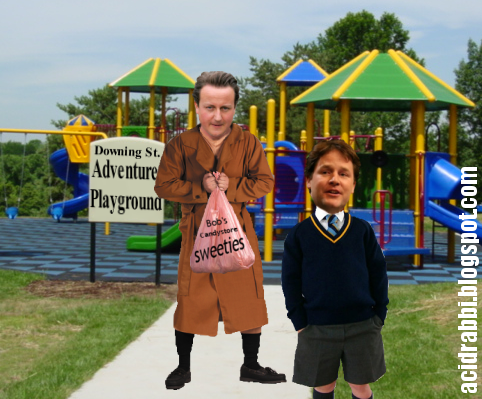
Laws goes for the throat and he's the most powerful tool his party has. At some point, perhaps soon and perhaps a long way off yet, the Conservatives are going to start wanting to stamp their authority over the funny little kids with whom they have formed not a friendship but a playground alliance which, as is always the case, will exist only so long as both parties have something to gain and when that happens Laws will be the only kid who can stand up to the bigger party and keep them from throwing their weight around. That's why, although we do not always support his policies, we know how valuable he is. Remember also that Laws has told his new Tory colleagues that were it not for Section 28, the notorious and controversial legislation that banned the "promotion of homosexuality" by local authorities and in the process effectively left teachers afraid to halt homophobic bullying and health centres afraid to provide sexual health advice to homosexuals, he would have been a member of their party rather than Clegg's. He knows how they work, because he shares 99% of their DNA.

As a result, when news broke that Laws was fighting for his political life after it emerged that he had claimed £40,000 over five years to cover the cost of renting a room in a property now known to belong to his partner James Lundie, we were inclined to look for a way in which his actions could be defended. After all, he immediately pledged to repay the amount in full and has referred himself to the Parliamentary Standards Commissioner, claiming that his intention has always been to "not maximise profit but to simply protect our privacy and my wish not to reval our sexuality." We felt a little sorry for him, because even politicians have the right to a private family life, and we felt angry at a world in which to this day homosexuals are made to feel uncomfortable about being who they are, as openly gay as heterosexuals are straight, for fear that it will tarnish their reputations and other people's opinions of them, damaging their career and, in the case of politicians, lessening their chances of re-election.

The MP claimed up to £950 a month between 2004 and 2007 to pay for the sub-let of a room in a flat in South London, where Mr. Lundie was registered as owner and co-occupant. This property was then sold, making Lundie a profit of £193,000, at which point he purchased a nearby house for £510,000 - Laws then registered a room at this new property as his second home, allowing him to claim expenses on it as he has a main residence in his Yeovil constituency in Somerset and received £920 per month up until September 2009, when he switched to a new flat which he designated as his official second home so that he could claim expenses for that one instead.

Parliamentary rules allow some degree of interpretation as to what defines an MP's partner, but according to Laws himself the official definition is "one of a couple...who although not married to each other or civil partners are living together and treat each other as spouses. Although we were living together, we did not treat each other as spouses. For example, we do not share bank accounts and indeed have separate social lives" (LibDemVoice) - and in the same article, he states that he and Lundie have been in a relationship since 2001. It doesn't matter how much of a degree of interpretation you allow, that sounds very much like the definition of a couple to us.

Since 2006, MPs have been banned from claiming expenses on property leased from a partner as the system was deemed too open to abuse even in the pre-scandal free-for-all (it's worth noting that unemployed people living in property belonging to their parents/siblings are not permitted to claim housing benefit to cover costs even if they are charged rent and have not been allowed to do so for many years - a friend at college who, in the early 1990s, was charged £30 per week rent by his mother from the £33 that the Government considered a sufficient amount for him to survive on, leaving him 42p a day to feed and clothe himself springs to mind).

Poor old David, eh? Forced to live a lie and risk his own honest reputation because of society's cruelty and still-present homophobia.

Hang on. Just a minute. Laws was a millionaire at 28, is now 44 and has been an MP earning a big, fat MP salary since 2001 - one would probably be quite correct in assuming he has a bank balance a fair bit greater than a million quid these days. Information on his personal wealth doesn't seem to be available (and quite rightly too, he has every bit as much right to keep that private as he does his personal life), but it's probably safe to say he'd doing alright for himself - not least of all as he is evidently perfectly capable of rustling up the £40k he's promised to pay back at a moment's notice. Mr. Lundie is employed by a public relations company and can probably be assumed to earn a pretty reasonable wage too.

"James and I are intensely private people," Laws says. "We made our decision to keep our relationship private and believed that was our right." It is indeed their right, but if they wanted it to be private would it not have been far more practical to pay their own way so that Laws' expenses were equally as private and not open to public scrutiny? Would it not have been better had Laws have gone straight to the Commissioner as soon as the scandal exploded into view last year?

We want to believe Laws because we've always liked him despite our disagreements with his right-wing politics, because we like knowing that a gay man (other than Lord of Darkness Mandelson) can hold a powerful government position in this day and age and most of all because the Liberal Democrat party needs him if it is not to be euthanised like an unwanted pet by the Conservatives once they tire of it.

Sadly, even though he stopped claiming expenses for the room in Lundie's house last year, we cannot believe him because it seems to us that he never needed this money and when he saw an opportunity to line his own pockets at our expense, he took it.

28/05/2010

The Axeman cometh...

"Tory proposals may result in delicate operations being performed by a crazed axeman rather than by a doctor," warn experts.

16/05/2010

Acid Rabbi Poll Results - The ConLib Coalition

Politics fans might want to sit down before reading on, because hot on the heels of the General Election comes... drum roll... the results of the Acid Rabbi poll! And as if that wasn't enough excitement, it seems the whole nation has gone utterly election crazy because we had a record response to this one: an amazing nine - yes, nine - people took the time to let us know what they thought of the Liberal Democrat/Conservative coalition.

As you can see, just 22% of those who took part believe the coalition to be a good thing with the same amount reckoning it to be bad. But 55% - a figure sufficient to dissolve Parliament even if Dave and Nick get their way - think it's terrible. Whether you agree with first-past-the-post or proportional representation, those numbers speak for themselves: most people, among those who voted and whatever their political allegiances, do not support the coalition.

Now, if we assume nine people is a sufficient number to be indicative of the nation as a whole we'll probably have to factor in some space for statistical error (space equal to the size of the Gulf of Mexico oil slick ought to do it); but we're probably at least relatively safe in assuming that if 55% of nine people do not support something, it's unlikely that 100% of 57 people will support it - thus, it seems a little odd that this is the level of support the coalition achieved among LibDem MPs. This suggests any of three factors: one, they're all too scared to stand up for themselves; two, they've ignored the thoughts and fears of party councillors, activists and voters; three, they know something we don't, which was kept from us by the secrecy surrounding the coalition negotiations.

Result of one is the Tories are going to eat them alive and the LibDems risk vanishing forever; result of two is the LibDem-voting electorate become angry and take their support elsewhere which, as Tory-hating supporters are already jumping ship and joining Labour may well result in the LibDems vanishing forever; result of three is the LibDem councillors, activists and voters become very angry and demand Nick Clegg's head, causing the party to lose the most charismatic leader it's had in decades, face further years in the wilderness and risk vanishing forever - though if three is the case, the party will probably get away with it just so long as the last week's success doesn't prove to be a honeymoon and married life continues to be bliss from a LibDem point of view.

Only time will tell.

Anyway, time for a new poll. Who do you think will be the next Labour leader?

15/05/2010

Does the 55% Rule rule out democracy?

With everything that's been going on this week in the wake of the election and the Cameron/Clegg marriage, the proposed 55% rule hasn't had even half the impact it would at any other time. However, it's certainly sent waves through Parliament, with even veteran MP Richard Ottaway, a prospective chair of the powerful Tory 1922 Committee, entering the row by warning the move could end the "primacy of Parliament."

The happy couple...but for how long?

In short, the rule will mean that for Parliament to be dissolved prior to the end of the newly fixed five year terms, at least 55% of MPs must vote in favour, rather than 51% as has previously been the case. David Cameron agreed the rule with his new Liberal Democrat friends to reassure them that his party will not back out of the coalition deal should his party achieve opinion poll success and call a General Election safe in the knowledge that the Conservatives could gain sufficient MPs to form a majority.

You might be thinking that this seems unusually altruistic, and you'd be correct: from Cameron's point of view, it also has the valuable side-effect of meaning that, should the coalition fail - as many supporters and activists of both parties believe it ultimately will, with many MPs in all likelihood secretly thinking the same thing - it means that the opposition, be it Labour or a future Labour-LibDem coalition, would find it very difficult to garner enough support to call for Parliament to be dissolved prior to the end of the five year term. This means that, should the pact fail, the Conservatives would be able to continue as the ruling party even without a majority - almost a guarantee that they could stay in power despite their failure to win last week's election.

Christopher Chope, Conservative MP for Southampton Itchen between 1983 and 1992 and Christchurch since 1997, warns: "If the present government was to lose its majority in Parliament and wasn't able to operate as a minority government because it didn't enjoy the confidence of a sufficient number of MPs, then what is being suggested is that it would carry on."

"It is not the duty of Parliament to prop up this coalition," says Charles Walker, the Tory MP for Broxbourne in Hertfordshire (really nice Chinese restaurant called Sky City at the Tower Centre by the way, folks). He continues, "This is a matter of convenience, because clearly the leader of our party, David Cameron, wants a five year Parliament and the Liberal Democrats want fixed terms and they don't want there to be a General Election along the way. But if Parliament and the nation lose confidence in this coalition government, there should be a General Election, whether that is in two years or three years or four years."

Richard Ottaway, who like Mr. Chope has had a break from Parliament for just five years since 1983 after he lost his Nottingham North seat to Labour before winning Croydon South in 1992, calls the rule "constitutionally incoherent."

Cameron, naturally, defends the concept, claiming to be "the first Prime Minister in British history to give up the right unilaterally to ask the Queen to dissolve Parliament. This is a big change on our system, it is a big giving-up of power."


Is Cameron one of the many who privately expects the coalition to fail? You can choose to believe he's doing this to give more power to MPs of all parties and to reassure the LibDems or you can choose to believe that he's seeking a way in which he can guarantee himself a full five year term even if the nation wants him and his party out of power, but you'd have to be a very committed DavCam fan indeed if you didn't think he had a bigger smile on his smug face when Nick Clegg put this one on the debating table than he does when his butler whips the cloche off a silver platter piled high with lobsters, white truffles and Beluga.

14/05/2010

Stunning new astronomy images


NtASA have published stunning new photographs showing the moment that, using its enormous gravitational pull, the vast M27/NGC 6835 galaxy ("The Oak") strips countless stars from the M64/NGC 4826 dwarf galaxy ("The Yellowbird") that orbits it, incorporating them into its own mass. Astronomers believe that, in time, the larger body will completely absorb its tiny neighbour.

12/05/2010

The Beautiful Yellow Bird - A Cautionary Tale for New MPs

Once upon a time, there lived a beautiful yellow bird. Her name was Liberal Democracy and many of those who saw her said she was the most beautiful bird in the land.


But the beautiful yellow bird was unhappy, for no matter where she looked she just couldn't find anywhere to build herself a safe and cosy nest. For years, she flew this way and that but to no avail. Finally, she gave up. "Oh," she cried, "How will I ever build a nest so I can lay my eggs and hatch more beautiful yellow birds?"

Then, one day, she came across a mighty oak tree. The oak tree was tall and stout. She flew thrice around the tree, admiring its many green leaves and strong boughs.


"Perhaps, after all this time, I've found the perfect place to build my nest!" the beautiful yellow bird exclaimed. "This mighty oak tree looks so strong, I'm certain it could weather any storm and keep my nest safe and sound!"

Then the beautiful yellow bird heard a voice: "Why, you're such a beautiful yellow bird that I'd be honoured if you would build your nest among my boughs. We could keep each other company in the storms - sometimes the wind blows so hard that even I feel afraid. I'd look after your eggs and help you hatch them out!"

The beautiful yellow bird was astounded to hear the tree speak to her, but she felt so relieved to have found the perfect place after so long that she flew straight to the tree and perched high up among its leaves.


Soon the beautiful yellow bird set to work, gathering lots of twigs and pieces of soft moss, and she built a safe and cosy nest among the strong boughs of the mighty oak tree. It was such a lovely nest that she felt secure and comfortable, so it was not long until...


...she laid three eggs! Would you like to count them? 1...2...3!

Within a few weeks, the eggs hatched in lovely little yellow fluffy chicks and the beautiful yellow bird tended to them, feeding then every day in the hope that they would grow up to be big and strong. When they were old enough, she asked them what they wanted to do when they left the nest and how they would bring joy to all who saw them, just as she had done.

"I want to make the world a better place," said the first chick, "by introducing a way that means when we decide who shall be our next ruler, we choose the one that most people want."

"I want to make the world a better place," said the second chick, "by introducing a way that means that the rich people have to pay more taxes than the poor people."

"I want to make the world a better place," said the third chick, "by teaching people that it's wrong to throw their rubbish into the fields and rivers so that the land doesn't become poisoned."

The beautiful yellow bird was proud of her chicks and she hoped that the day would come when they would be able to realise their ambitions and make the land a happier place for everyone. But then, all of a sudden, she heard a strange rustling noise coming from among the mighty oak tree's leaves.

"Oh! Whoever could it be?" she cried, wondering who else could be in the mighty oak tree. "I do hope it's some visitor, come to admire my chicks!"

But it was not a visitor come to admire her chicks. With dismay, the beautiful yellow bird saw that it was four of the greediest, fattest cats she had ever seen.


"Ha ha! We tricked you, beautiful yellow bird," said the greedy fat cats. "We made you think the oak tree welcomed you and your chicks, but it was us all along! Trees can't talk!"

With that, three of the greedy fat cats pounced upon the chicks and ate them all up, before the greediest, fattest cat of them all caught the beautiful yellow bird in his razor-sharp claws and chewed her into little pieces, eating them in turn until there was nothing left of her.

The chicks never did get to do the wonderful things they had promised their mother, and never again was such a beautiful yellow bird seen flying over the land.

The End.


11/05/2010

2015

After five long years in a bunker the Liberal Democrats emerge blinking among the rubble, unscathed by the battles that have dogged the minority Tory government and ready for government.

Clegg and Cameron - when love ends


Ever made the mistake of putting off something your partner wants to do - maybe a holiday, moving in together, marriage, something pervy - for so long that eventually they decide you're never going to do it and move on? And then you're wracked with remorse so you contact them and beg them to come back, promising you'll do anything they ask in future, but it's all too late because they've found someone else who does do whatever it was you wouldn't?

Well anyway - let's just hope Clegg makes the right decision. The Liberal Democrats would be so much better off with Labour, rather than being Cameron's bitches. You go, girl!

09/05/2010

Results of the LibDem/Tory pact

Messrs. Cameron and Clegg in a breakfast meeting at the Conservative Party HQ, one summer morning a couple of months after forming a coalition in the wake of the 2010 General Election.

08/05/2010

The LibDems should "Just Say No" to the Tories

Just prior to noticing a bottle of 25-year-old Laphroaig has appeared recently behind the bar and thus ending up unable to hold conversation, Acid Rabbi conducted a short informal survey among friends and acquaintances in the pub last night so as to be able to get some idea of popular public opinion re. the probable Conservative/Liberal Democrat pact.

The general consensus appears to be as follows:

Tory voters: "Who cares?"
Labour voters: "No! We need them! And they have more in common with us!"
LibDem voters: "If Clegg goes for it, I'm never voting LibDem again."

No, Nick! Those sweeties are poisoned!

Let's have a look at those in reverse order. LibDem voters, it seems, feel cheated by the prospect of a pact between the two parties - this is, in large part, because with the LibDems edging slightly leftward and Labour wholeheartedly stomping rightward ever since 1997 and the rise of Blair, the LibDems are frequently left of Labour these days. This has caused many traditional Labour voters, finding themselves without a Socialist option to vote for in national elections, to up sticks and support the LibDems instead; these being the sorts of people who maintain a deep-seated loathing for the Tory party and all Tory policy. Other - traditional - LibDem voters will feel, if such a pact is made, that they have been duped and that their LibDem vote was a scam, allowing the Tories into power. So, all in all, Nick Clegg risks alienating a large percentage of LibDem support.

The LibDems quite probably do have more in common with at least some sections of the Labour party, which still has a few traditionally-minded MPs - the hoary old socialist warhorses are long gone now, but there remains a phalanx of leftists who spend most of their time being quiet nowadays but, once in a while, wake up; as is the case with the Socialist Campaign Group, to whom the Dark Lord Mandelson was almost certainly referring when he warned Gordon Brown of a shadowy group of MPs who sought nothing less than his downfall back in June last year. Groups like that might very well make good allies for the LibDems - not least of all because the SCG advocates the scrapping of both Trident and ID cards, both LibDem policies.

Tory voters are so convinced that, due to the Conservatives being the largest party in the Commons, they have won the election that they don't seem to see any need to form a coalition with anyone, thank you very much. They may well be right: the party came so much closer to an overall majority than either Labour or the LibDems that if another General Election is called soon, as is very likely to be the case due to the hung parliament, they won't have anything like as much work to do to achieve the extra seats they need. This, however, does not necessarily make them a backdoor to power for the LibDems, because it seems highly unlikely that David Cameron will allow many of Clegg's requests - the Conservatives are far less favourable when it comes to the EU than the LibDebs, are absolutely opposed to scrapping Trident and, Cameron has made clear since the election, not willing to even discuss electoral reform in any seriousness. All of which are matters very close to Liberal Democrat hearts.

As we all know, we're going to see deep and savage cuts in all sorts of services and raised taxation may well become necessary as, at the time of writing, each and every British taxpayer needs to pay over £32,000 if the nation is to pay off its debts (there's a counter at the bottom of this page if you want to know the exact figure). Though all three main parties discussed this at great length during the run up to the election, the matter was heavily glossed-over during public debate, leaving us in the dark about just how savage these cuts will need to be - the only thing that seems certain is the next few years are going to be very hard indeed. Whichever party finds itself in power - either by forming a pact with the LibDems or, as Labour would need to do, with the LibDems and some other groups - might just find it has shot itself in the foot here, because when the public feel those cuts and realise how deep they are, they're not going to be happy. Had we have been properly warned, we might have had time to accept - but we haven't been properly warned, so many people will react with anger which, in five years' time when another General Election comes round, will probably manifest itself as a massive swing away from whichever party finds itself on top once we're out of the current hung parliament mess.

Whichever party that is, it's likely to find itself all but annihilated for at least ten years, possibly a generation. The larger parties would, in time, recover - it'd hurt the Tories but they'd survive, just as they survived Blair. Labour would be hit hard, but they too would survive - they managed to live on after the disastrous 1983 election when under Michael Foot's leadership they were hammered by the Conservatives, led by Margaret Thatcher who was riding high following the UK's triumph in the Falklands. The Liberal Democrats, however, despite having seemed strong enough to move into second place in the Commons just two and half weeks ago, are a considerably smaller and weaker party, as has been shown by Thursday's results. A body blow of the type they'd experience if they're part of the next government might easily finish them off for good - it could well be a killer punch, rather than the mere knockout it would be for the bigger parties.

With that in mind, the best thing for Nick Clegg to do could be to take a step back and forget power for the time being, ride out the storm and wait, keeping his party intact and independent. A week is a long time in politics yet, strangely, five years is not. If the Tories rise to the top, the electorate - when they're fed up, aching and furious that they weren't warned about the extent of the trouble ahead - will be wanting to make their anger felt. Many, looking at Labour, will still remember how determined they were to punish them in 2010 and so instead they'll want an alternative - and the LibDems, promising once again a different, fresh approach - will be there, with Nick Clegg working the magic we saw in the Leader's Debates and Vince Cable seeming as ever a much more human prospect than George Osborne, looking for all the world like an attractively-wrapped birthday gift.

Your time will come, Mr. Clegg. Just have patience.

23/04/2010

BNP to LibDems? WTF?

Not too far from Acid Rabbi Towers is a house that, during the European Elections last year, had a BNP poster displayed in its window. Mrs. Rabbi, who walks past the house daily, regularly sees the man who lives there and so we know for a fact that the man who put up the BNP poster is still living there.

Today I walked past and guess what? He has a big Liberal Democrat poster on display. Explain that if you can.

We have no BNP candidate standing here, so he wouldn't have been able to vote for them anyway - but nevertheless, if you have any belief in the BNP and their extreme right wing policies, you're unlikely to pick the central left LibDems as an alternative so what could possibly have caused such a seismic shift in one man's opinions?

If it was Nick Clegg's performance in last week's Leaders' Debate, then Mr. Clegg can be assured he achieved something in this election even if he's not the Prime Minister by May the 7th because convincing even one individual not to vote for the fascists is worthy of praise.

One thing that does still concern us is that the ex-BNP supporter also has a Status Quo poster in his window (which seems a peculiar mix). While opposing everything the BNP say and do, we respect the right of each member of the electorate in this democratic nation to support any political party they choose - but try as we might, we can see no excuse whatsoever for liking Quo.

19/04/2010

Results in!


Yes folks, it's the moment you've been waiting for - the results of the latest Acid Rabbi poll are in, and an amazing five people took the time to vote so you can bet your own grandmother this will tell you something truly meaningful about popular opinion in Britain today!

We asked:

"Is David Cameron...

A: An honest man who will do his best for Britain?

B: A transparent ballot-whore who will say anything if he thinks there's a vote in it?

C: A sort of cross between an arse and a potato?"

Answer A received a grand total of no votes at all, leading us to believe that - unsurprisingly - no Tories read Acid Rabbi. Answer B got 80% - four votes, which suggests not everyone's taken in by the shameless liar. Answer C - our choice - scored 40%, two votes, due to the fact that we allowed people to vote twice and made the results pretty much useless as a result.

How will you vote on May the 6th?

Ah well - let's hope the vote on May the 6th isn't too different. Even another Labour term has to be better than DavCam and his gang. Anyway - now vote in our new poll: How do you intend to vote int he General Election - Conservative, Labour, LibDem, Green, UKIP, Fascist Scumbag Party (also known as the BNP) or by writing "Fuck Off" on a brick and chucking it through a House of Commons window?

16/04/2010

The Leaders' Debate: a mere sideshow trifle

This was, without doubt, the worst Kraftwerk gig I've ever watched.

The circus was well and truly in town for one night only in Manchester last night, with three clowns bringing joy and light into the lives of the benighted serfs that inhabit the God-forsaken hole. David Cameron, Gordon Brown and Nick Clegg each performed a hilarious comedy routine with much slapstick, custard pie throwing and tipping of buckets full of brightly coloured confetti into one another's pants. The crowd went wild - or at least, they would have done, but "pre-arranged rules" and in all likelihood cattle prod-wielding security ensured they remained rooted to their seats and kept shtum. A Question Time audience would have jeered themselves hoarse.

The general consensus is that the boy Clegg, who looked about 20, did rather well for himself - he looked calm and relaxed and even cracked a semi-joke or two at the others expense. Cameron was caught by surprise on a number of occasions by presenter Alastair Stewart, who wasn't taking shit from anyone, when he was cut off mid-flow and left gawping "but...but..." like a semi-sentient goldfish. Brown, bless his little tartan socks, tried his best and forced a smile or two, but as is his downfall he came across as dour, moody and tired. Opinion polls today seem to agree Cleggy delivered - the LibDems are showing a marked upturn, while Labour and the Tories dive downwards. It'd not enough to win them the election, but if Nick can keep it up they may well be in for their best result in decades.

The leaders discussed a variety of issues, including Acid Rabbi favourites immigration (none of them taking quite as liberal a position as we would - ie; let people go where they want when they want - but it's apparent each party has some reasonably solid ideas. Sadly all ideas based on dealing with widespread public worries by limiting immigration rather than educating them so they understand immigration is more likely to solve than cause problems, but there you have it. Clegg pulled a real trick on this one by being the only participant to actually say something nice about immigrants, a fact that will do him no end of favours since the majority of British people are not racist) and MP's expenses, which took the form of the usual "we're really, really sorry" with a noticeable lisp on the 's' in sorry which is hissed out by their devious, forked tongues. This one was always going to play well for Clegg as the LibDems came out of the expenses scandal in far better shape than the other main parties. Cameron and Brown made all the usual noises but it was evident that the stage, which looked rather like it had been cobbled together from 1988-vintage Countdown sets (and thinking of it, doesn't Alastair Stewart look a little like a cadaverous Richard Whiteley?) had become a very uncomfortable place.

The economy took up a fair chunk of the show and Mrs. Rabbi, who is a woman and thus has a keen eye for details such as this, noted that the cost of Parliament for 2010 could have been reduced dramatically had the three amigos chosen to wear something out of their wardrobes or an off-the-peg BHS suit rather than each spending something probably not far off the average British family's monthly income on some admittedly fine-lookin' threads. Clegg - easily the cutest of the three, says Mrs. Rabbi - wore a smooth charcoal grey number with a LibDem yellow tie and he wore it well, looking relaxed, comfortable and even cool. Cameron, as ever, looked like a boiled potato in a regulation dark blue Tory suit with blue tie but having been born in Savile Row's finest it was a boiled potato dressed with the very finest mayonnaise. His shoes looked like they probably worth as much as a healthy pair of kidneys on the black market (and who knows? Being a Tory, they may well have been made of kidneys ripped from the lithe young body of a working class teenager). Brown went for dour-yet-dependable black. That he - a man who is not in the very best of shape - looked notably prime ministerial is token of his tailor's admirable skills. He wore the Red Tie of Socialism, which he possibly sees as a suitable replacement for flying the Red Flag that his predecessor ripped up and burnt back in 1997. Sadly, he was unable to sound prime ministerial and came across as slightly confused, sad and wishing he was elsewhere.

That got us thinking - what did the gig actually achieve, especially when so many important matters - technology, the Middle East and so on - were not mentioned? Well: Clegg persuaded a few undecideds who vote according to how good a candidate looks on the telly that they should go with him and Cameron and Brown convinced a few others that doing so might not be a bad idea. That was about it, really. But it's not even nearly enough to make a LibDem government a likely prospect - while the Daily Telegraph claims that if the General Election was held today, the LibDems would win 159 seats (Labour would win 165, the Tories 294), Clegg's inability to throw himself headlong into political scraps will ensure last night's performance is forgotten by all but a few pundits and bloggers by the 6th of May so if anything it just makes a hung parliament look more probable. Secondly, what did it cost? ITV, perhaps because they took the unusual decision not to screen any adverts for the full 90 minutes, spent little - the set probably cost about a fiver and whereas Stewart is doubtless not on minimum wage whatever they paid him will be seen as a bargain in return for 9.8 million viewers (plus however much other channels pay them for the right to show the debate) - but whatever they spent will have been covered by their own budget, which is made up of what advertisers pay them. How much, we wonder, did it cost us, the tax-payers?

It was obvious that in addition to their posh suits and shiny shoes, each leader had been subject to a whole host of image consultants, stylists and who knows what else over the last few weeks. Their voices may have faltered as they argued around tricky points, but visually all three men were stunning. Clegg, who had been jotting down notes throughout, made a great show of reciting the names of those who had asked questions (including Joel, the rabbi's son who drove Nick Griffin into a corner during his notorious Question Time appearance and wouldn't let him out again, a lad who will probably be presenting programmes of this type in a few years' time) and thanking them - perhaps it was insincere and a calculated attempt to make him look more human, but coming at the end of 90 minutes in which he had shown himself to have infinitely better manners than his rivals it was PR gold and charmed the crowd. Brown, perhaps realising suddenly that this was his last chance to show he too cares about the proles, made a last ditch effort and shook hands with a few members of the audience. Cameron stood staring ahead, as if trying to work out whether or not his performance was sufficiently poor to put his party behind Labour in the polls - it wasn't, though we're not going to pretend you didn't do a piss-poor job last night, posh boy.

Many bloggers are calling the debate a gladiatorial contest but we disagree. While entertaining, it was nothing more than an mildly amusing circus routine. Some people will have decided who to vote for last night, but let's credit the public with some intellect - most people don't vote according to how nice Clegg, Cameron or Brown's suit looks, how shiny their shoes are or how accomplished a performer on stage they are (though I have to admit, had one of them showed up in paratrooper boots, combat trousers and a Crass t-shirt they'd have earned a lifetime's party membership fees from me). Even in these days of gym-joining narcissism, botox and celebrity-worship, the majority of the electorate vote for the candidate representing the party that supports the views they share and the causes they believe in. The Liberal Democrats scored some valuable points last night, the Conservatives lost some and Labour flogged a dead horse but all three demonstrated their belief that the public are a bit thick with loyalties that can be bought for a few shiny trinkets.