Showing posts with label tory party. Show all posts

28/05/2010

Tories to revitalise economy


David Cameron outlines Conservative proposals aimed at "revitalising" the British economy: "A little birdy tells me that Greece is on the rock'n'roll. So wot I'm suggestin' is me, Gorgeous George, Hatchet Hague, Boris the Blade and anovver few lads wait outside the IMF and when they come out, we duff 'em over their 'eads and scarper wiv the cash. Oh - and call me Dodgy Dave from now on, alright?"

The Axeman cometh...

"Tory proposals may result in delicate operations being performed by a crazed axeman rather than by a doctor," warn experts.

16/05/2010

Acid Rabbi Poll Results - The ConLib Coalition

Politics fans might want to sit down before reading on, because hot on the heels of the General Election comes... drum roll... the results of the Acid Rabbi poll! And as if that wasn't enough excitement, it seems the whole nation has gone utterly election crazy because we had a record response to this one: an amazing nine - yes, nine - people took the time to let us know what they thought of the Liberal Democrat/Conservative coalition.

As you can see, just 22% of those who took part believe the coalition to be a good thing with the same amount reckoning it to be bad. But 55% - a figure sufficient to dissolve Parliament even if Dave and Nick get their way - think it's terrible. Whether you agree with first-past-the-post or proportional representation, those numbers speak for themselves: most people, among those who voted and whatever their political allegiances, do not support the coalition.

Now, if we assume nine people is a sufficient number to be indicative of the nation as a whole we'll probably have to factor in some space for statistical error (space equal to the size of the Gulf of Mexico oil slick ought to do it); but we're probably at least relatively safe in assuming that if 55% of nine people do not support something, it's unlikely that 100% of 57 people will support it - thus, it seems a little odd that this is the level of support the coalition achieved among LibDem MPs. This suggests any of three factors: one, they're all too scared to stand up for themselves; two, they've ignored the thoughts and fears of party councillors, activists and voters; three, they know something we don't, which was kept from us by the secrecy surrounding the coalition negotiations.

Result of one is the Tories are going to eat them alive and the LibDems risk vanishing forever; result of two is the LibDem-voting electorate become angry and take their support elsewhere which, as Tory-hating supporters are already jumping ship and joining Labour may well result in the LibDems vanishing forever; result of three is the LibDem councillors, activists and voters become very angry and demand Nick Clegg's head, causing the party to lose the most charismatic leader it's had in decades, face further years in the wilderness and risk vanishing forever - though if three is the case, the party will probably get away with it just so long as the last week's success doesn't prove to be a honeymoon and married life continues to be bliss from a LibDem point of view.

Only time will tell.

Anyway, time for a new poll. Who do you think will be the next Labour leader?

15/05/2010

Theresa May not believe in equality for gays

We were intrigued to discover on the invaluable TheyWorkForYou website that new Equality Minister Theresa May "voted moderately against equal gay rights." Equality regardless of gender, race, sexual preference/identity is, after all, generally considered to be a good thing these days by all but a limited number of morons, and so you'd probably be safe in assuming that the Government would as a result wish to promote such a worthy ideal. You might therefore also assume that anyone thought suitable to the post of Equality Minister would vote very strongly for equal gay rights, wouldn't you?

Theresa May MP, Equality Minister - seems to not like gay people very much.
(image from Wikipedia, used in accordance with Creative Commons Attribution 3.0 licence)

Our interest was piqued, so we ran a quick Google search using the request "Theresa May gay lesbian equality" and very rapidly found a document published by Pink News which lists some revealing facts on May - like, for example, the time in 1998 when she voted against equalising the age of consent for homosexuals and heterosexuals. Then, in 2000, she voted against moves to repeal the notorious Section 28 (commonly known as Clause 28), a piece of legislation that banned local authorities from "promoting homosexuality" and effectively left health centres unable to provide sexual health advice to gays and made teachers afraid to prevent homophobic bullying of school children.

Mrs. May was voting in a way rather at odds with equality again in both 2001 and 2002, when she supported measures aimed at preventing same-sex couples from adopting children. There was a brief moment in 2004 when it looked like she might have given up her prejudice as - in common with the majority of the Conservative front bench - she voted in favour of civil partnerships, known to many as gay marriages; but it's worth noting that over the last few years the Tories have been attempting to attract the so-called pink vote and will say or do just about anything if they think someone will cross their box at the ballot, as has been the case with Prime Minister David Cameron when he apologised for Section 28 last year (this despite the fact that his record when it comes to gay rights isn't a great deal better than May's - he also voted against repealing Section 28). However, in the very same year, she didn't vote in any of the four votes that eventually led to the adoption of the Gender Recognition Act 2004, which allows those who have undergone gender correction surgery to legally change the gender recorded on their birth certificate and other documents.

In 2008, she voted in favour of an ultimately defeated bill which would have required couples seeking IVF treatment to provide a male role model - in other words, preventing lesbian couples from having children by this method (Cameron voted in favour of that one too, by the way).

No mainstream political party would discriminate against Jewish, black or Asian MPs in this day and age, but one does have to wonder - in view of the dubious voting records of both their leader and Equality Minister, as well as the decision to join the European Conservatives and Reformists group in the EU, thus allying themselves with the openly homophobic Polish Prawo i Sprawiedliwosc party which we have written about on this blog at some length - if the Conservatives are not yet as comfortable with homosexuality. Last week's election saw ten new Conservative homosexuals take seats in the Commons, but they may find they are merely tolerated in order to provide the illusion of equality rather than welcomed with open arms.

If you think Theresa May is unsuited to her new post, have a look at Sack Theresa - Calling for the resignation of the Women and Equalities Minister.

Does the 55% Rule rule out democracy?

With everything that's been going on this week in the wake of the election and the Cameron/Clegg marriage, the proposed 55% rule hasn't had even half the impact it would at any other time. However, it's certainly sent waves through Parliament, with even veteran MP Richard Ottaway, a prospective chair of the powerful Tory 1922 Committee, entering the row by warning the move could end the "primacy of Parliament."

The happy couple...but for how long?

In short, the rule will mean that for Parliament to be dissolved prior to the end of the newly fixed five year terms, at least 55% of MPs must vote in favour, rather than 51% as has previously been the case. David Cameron agreed the rule with his new Liberal Democrat friends to reassure them that his party will not back out of the coalition deal should his party achieve opinion poll success and call a General Election safe in the knowledge that the Conservatives could gain sufficient MPs to form a majority.

You might be thinking that this seems unusually altruistic, and you'd be correct: from Cameron's point of view, it also has the valuable side-effect of meaning that, should the coalition fail - as many supporters and activists of both parties believe it ultimately will, with many MPs in all likelihood secretly thinking the same thing - it means that the opposition, be it Labour or a future Labour-LibDem coalition, would find it very difficult to garner enough support to call for Parliament to be dissolved prior to the end of the five year term. This means that, should the pact fail, the Conservatives would be able to continue as the ruling party even without a majority - almost a guarantee that they could stay in power despite their failure to win last week's election.

Christopher Chope, Conservative MP for Southampton Itchen between 1983 and 1992 and Christchurch since 1997, warns: "If the present government was to lose its majority in Parliament and wasn't able to operate as a minority government because it didn't enjoy the confidence of a sufficient number of MPs, then what is being suggested is that it would carry on."

"It is not the duty of Parliament to prop up this coalition," says Charles Walker, the Tory MP for Broxbourne in Hertfordshire (really nice Chinese restaurant called Sky City at the Tower Centre by the way, folks). He continues, "This is a matter of convenience, because clearly the leader of our party, David Cameron, wants a five year Parliament and the Liberal Democrats want fixed terms and they don't want there to be a General Election along the way. But if Parliament and the nation lose confidence in this coalition government, there should be a General Election, whether that is in two years or three years or four years."

Richard Ottaway, who like Mr. Chope has had a break from Parliament for just five years since 1983 after he lost his Nottingham North seat to Labour before winning Croydon South in 1992, calls the rule "constitutionally incoherent."

Cameron, naturally, defends the concept, claiming to be "the first Prime Minister in British history to give up the right unilaterally to ask the Queen to dissolve Parliament. This is a big change on our system, it is a big giving-up of power."


Is Cameron one of the many who privately expects the coalition to fail? You can choose to believe he's doing this to give more power to MPs of all parties and to reassure the LibDems or you can choose to believe that he's seeking a way in which he can guarantee himself a full five year term even if the nation wants him and his party out of power, but you'd have to be a very committed DavCam fan indeed if you didn't think he had a bigger smile on his smug face when Nick Clegg put this one on the debating table than he does when his butler whips the cloche off a silver platter piled high with lobsters, white truffles and Beluga.

14/05/2010

Stunning new astronomy images


NtASA have published stunning new photographs showing the moment that, using its enormous gravitational pull, the vast M27/NGC 6835 galaxy ("The Oak") strips countless stars from the M64/NGC 4826 dwarf galaxy ("The Yellowbird") that orbits it, incorporating them into its own mass. Astronomers believe that, in time, the larger body will completely absorb its tiny neighbour.

12/05/2010

The Beautiful Yellow Bird - A Cautionary Tale for New MPs

Once upon a time, there lived a beautiful yellow bird. Her name was Liberal Democracy and many of those who saw her said she was the most beautiful bird in the land.


But the beautiful yellow bird was unhappy, for no matter where she looked she just couldn't find anywhere to build herself a safe and cosy nest. For years, she flew this way and that but to no avail. Finally, she gave up. "Oh," she cried, "How will I ever build a nest so I can lay my eggs and hatch more beautiful yellow birds?"

Then, one day, she came across a mighty oak tree. The oak tree was tall and stout. She flew thrice around the tree, admiring its many green leaves and strong boughs.


"Perhaps, after all this time, I've found the perfect place to build my nest!" the beautiful yellow bird exclaimed. "This mighty oak tree looks so strong, I'm certain it could weather any storm and keep my nest safe and sound!"

Then the beautiful yellow bird heard a voice: "Why, you're such a beautiful yellow bird that I'd be honoured if you would build your nest among my boughs. We could keep each other company in the storms - sometimes the wind blows so hard that even I feel afraid. I'd look after your eggs and help you hatch them out!"

The beautiful yellow bird was astounded to hear the tree speak to her, but she felt so relieved to have found the perfect place after so long that she flew straight to the tree and perched high up among its leaves.


Soon the beautiful yellow bird set to work, gathering lots of twigs and pieces of soft moss, and she built a safe and cosy nest among the strong boughs of the mighty oak tree. It was such a lovely nest that she felt secure and comfortable, so it was not long until...


...she laid three eggs! Would you like to count them? 1...2...3!

Within a few weeks, the eggs hatched in lovely little yellow fluffy chicks and the beautiful yellow bird tended to them, feeding then every day in the hope that they would grow up to be big and strong. When they were old enough, she asked them what they wanted to do when they left the nest and how they would bring joy to all who saw them, just as she had done.

"I want to make the world a better place," said the first chick, "by introducing a way that means when we decide who shall be our next ruler, we choose the one that most people want."

"I want to make the world a better place," said the second chick, "by introducing a way that means that the rich people have to pay more taxes than the poor people."

"I want to make the world a better place," said the third chick, "by teaching people that it's wrong to throw their rubbish into the fields and rivers so that the land doesn't become poisoned."

The beautiful yellow bird was proud of her chicks and she hoped that the day would come when they would be able to realise their ambitions and make the land a happier place for everyone. But then, all of a sudden, she heard a strange rustling noise coming from among the mighty oak tree's leaves.

"Oh! Whoever could it be?" she cried, wondering who else could be in the mighty oak tree. "I do hope it's some visitor, come to admire my chicks!"

But it was not a visitor come to admire her chicks. With dismay, the beautiful yellow bird saw that it was four of the greediest, fattest cats she had ever seen.


"Ha ha! We tricked you, beautiful yellow bird," said the greedy fat cats. "We made you think the oak tree welcomed you and your chicks, but it was us all along! Trees can't talk!"

With that, three of the greedy fat cats pounced upon the chicks and ate them all up, before the greediest, fattest cat of them all caught the beautiful yellow bird in his razor-sharp claws and chewed her into little pieces, eating them in turn until there was nothing left of her.

The chicks never did get to do the wonderful things they had promised their mother, and never again was such a beautiful yellow bird seen flying over the land.

The End.


11/05/2010

Clegg and Cameron - when love ends


Ever made the mistake of putting off something your partner wants to do - maybe a holiday, moving in together, marriage, something pervy - for so long that eventually they decide you're never going to do it and move on? And then you're wracked with remorse so you contact them and beg them to come back, promising you'll do anything they ask in future, but it's all too late because they've found someone else who does do whatever it was you wouldn't?

Well anyway - let's just hope Clegg makes the right decision. The Liberal Democrats would be so much better off with Labour, rather than being Cameron's bitches. You go, girl!

09/05/2010

Results of the LibDem/Tory pact

Messrs. Cameron and Clegg in a breakfast meeting at the Conservative Party HQ, one summer morning a couple of months after forming a coalition in the wake of the 2010 General Election.

08/05/2010

The LibDems should "Just Say No" to the Tories

Just prior to noticing a bottle of 25-year-old Laphroaig has appeared recently behind the bar and thus ending up unable to hold conversation, Acid Rabbi conducted a short informal survey among friends and acquaintances in the pub last night so as to be able to get some idea of popular public opinion re. the probable Conservative/Liberal Democrat pact.

The general consensus appears to be as follows:

Tory voters: "Who cares?"
Labour voters: "No! We need them! And they have more in common with us!"
LibDem voters: "If Clegg goes for it, I'm never voting LibDem again."

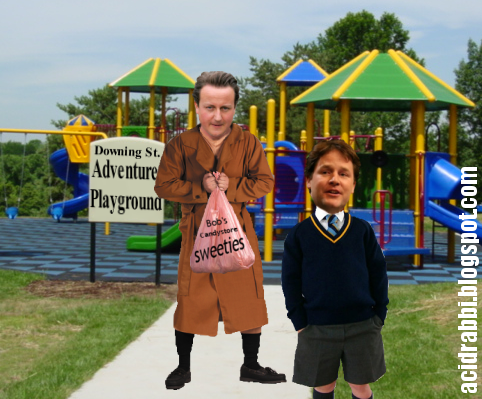
No, Nick! Those sweeties are poisoned!

Let's have a look at those in reverse order. LibDem voters, it seems, feel cheated by the prospect of a pact between the two parties - this is, in large part, because with the LibDems edging slightly leftward and Labour wholeheartedly stomping rightward ever since 1997 and the rise of Blair, the LibDems are frequently left of Labour these days. This has caused many traditional Labour voters, finding themselves without a Socialist option to vote for in national elections, to up sticks and support the LibDems instead; these being the sorts of people who maintain a deep-seated loathing for the Tory party and all Tory policy. Other - traditional - LibDem voters will feel, if such a pact is made, that they have been duped and that their LibDem vote was a scam, allowing the Tories into power. So, all in all, Nick Clegg risks alienating a large percentage of LibDem support.

The LibDems quite probably do have more in common with at least some sections of the Labour party, which still has a few traditionally-minded MPs - the hoary old socialist warhorses are long gone now, but there remains a phalanx of leftists who spend most of their time being quiet nowadays but, once in a while, wake up; as is the case with the Socialist Campaign Group, to whom the Dark Lord Mandelson was almost certainly referring when he warned Gordon Brown of a shadowy group of MPs who sought nothing less than his downfall back in June last year. Groups like that might very well make good allies for the LibDems - not least of all because the SCG advocates the scrapping of both Trident and ID cards, both LibDem policies.

Tory voters are so convinced that, due to the Conservatives being the largest party in the Commons, they have won the election that they don't seem to see any need to form a coalition with anyone, thank you very much. They may well be right: the party came so much closer to an overall majority than either Labour or the LibDems that if another General Election is called soon, as is very likely to be the case due to the hung parliament, they won't have anything like as much work to do to achieve the extra seats they need. This, however, does not necessarily make them a backdoor to power for the LibDems, because it seems highly unlikely that David Cameron will allow many of Clegg's requests - the Conservatives are far less favourable when it comes to the EU than the LibDebs, are absolutely opposed to scrapping Trident and, Cameron has made clear since the election, not willing to even discuss electoral reform in any seriousness. All of which are matters very close to Liberal Democrat hearts.

As we all know, we're going to see deep and savage cuts in all sorts of services and raised taxation may well become necessary as, at the time of writing, each and every British taxpayer needs to pay over £32,000 if the nation is to pay off its debts (there's a counter at the bottom of this page if you want to know the exact figure). Though all three main parties discussed this at great length during the run up to the election, the matter was heavily glossed-over during public debate, leaving us in the dark about just how savage these cuts will need to be - the only thing that seems certain is the next few years are going to be very hard indeed. Whichever party finds itself in power - either by forming a pact with the LibDems or, as Labour would need to do, with the LibDems and some other groups - might just find it has shot itself in the foot here, because when the public feel those cuts and realise how deep they are, they're not going to be happy. Had we have been properly warned, we might have had time to accept - but we haven't been properly warned, so many people will react with anger which, in five years' time when another General Election comes round, will probably manifest itself as a massive swing away from whichever party finds itself on top once we're out of the current hung parliament mess.

Whichever party that is, it's likely to find itself all but annihilated for at least ten years, possibly a generation. The larger parties would, in time, recover - it'd hurt the Tories but they'd survive, just as they survived Blair. Labour would be hit hard, but they too would survive - they managed to live on after the disastrous 1983 election when under Michael Foot's leadership they were hammered by the Conservatives, led by Margaret Thatcher who was riding high following the UK's triumph in the Falklands. The Liberal Democrats, however, despite having seemed strong enough to move into second place in the Commons just two and half weeks ago, are a considerably smaller and weaker party, as has been shown by Thursday's results. A body blow of the type they'd experience if they're part of the next government might easily finish them off for good - it could well be a killer punch, rather than the mere knockout it would be for the bigger parties.

With that in mind, the best thing for Nick Clegg to do could be to take a step back and forget power for the time being, ride out the storm and wait, keeping his party intact and independent. A week is a long time in politics yet, strangely, five years is not. If the Tories rise to the top, the electorate - when they're fed up, aching and furious that they weren't warned about the extent of the trouble ahead - will be wanting to make their anger felt. Many, looking at Labour, will still remember how determined they were to punish them in 2010 and so instead they'll want an alternative - and the LibDems, promising once again a different, fresh approach - will be there, with Nick Clegg working the magic we saw in the Leader's Debates and Vince Cable seeming as ever a much more human prospect than George Osborne, looking for all the world like an attractively-wrapped birthday gift.

Your time will come, Mr. Clegg. Just have patience.